
The guy in the background
A story about nature, running, and being rooted in a landscape.

My last post followed my ex-colleague Isaac and I on our forays into the Lake District crags to plant montane trees. One of the people I didn’t mention in that post was Pete Barron.
Pete is everywhere in the Lake District – which is funny because few would know who he is. Ask a fell runner to name the top Lakeland runners and they’d name Joss Naylor, the Blands, Ricky Lightfoot, and so on. But there are few people as Lakeland as Pete Barron.
I wrote the following piece for The Fellrunner a few years ago – a magazine that is sent to members of the Fell Runners Association. These stories are my absolute favourite to write: I love hearing someone talk about their life and experiences, and see what really drives them.
It’s a long piece, but I hope you enjoy it.
We come to a halt, our breath steaming slightly in the crisp November air. Pete Barron and I are walking along the bridleway above Rosthwaite, on the western slopes of the Borrowdale valley.
He has paused to point out Helvellyn, which stands out in brilliant clarity against the pastel blue sky. It’s a mountain he’s had a connection with for many years, essentially his office since 1991, first as a National Park Ranger for 23 years and latterly as property manager for the John Muir Trust.
“No joke, I know every stone”, he says, pointing out Helvellyn and Swirral Edge. “Not that I’ve put them in – some of them I have – but on this side, you could see that path up the front from Keswick about 25 years ago.”
I could imagine thousands of people who visit Helvellyn every year hardly batting an eyelid at the work going on around them. Never knowing who was often doing it quietly in the background.
I first met Pete when I started working for the John Muir Trust. Living and running in Scotland at the time, I wasn’t well-versed in the fell running scene south of the border. As I got to know Pete, I knew he was a good runner in his day, but that was as far as it went.
That was until I was flicking through a copy of It’s a Hill, Get Over It, when an instantly recognisable figured jumped out at me: there, in a Helly Hansen baselayer and Keswick AC vest, already sporting a receding hairline, was Pete Barron, right next to Billy Bland at the end of his record-setting Bob Graham Round.
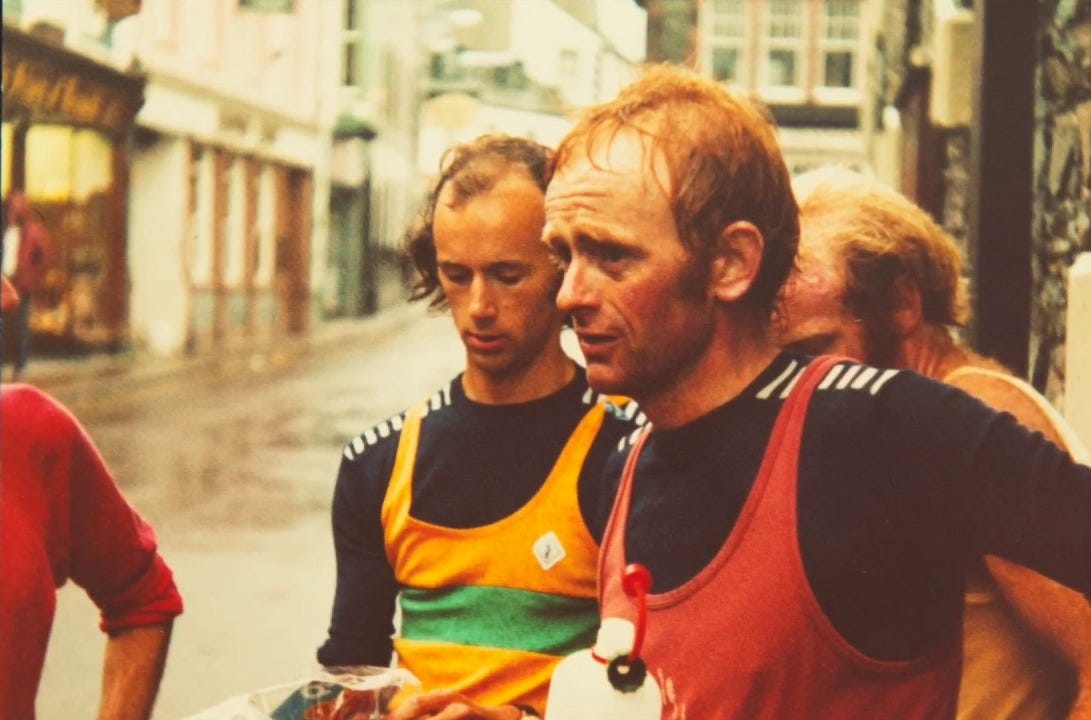
The incident was repeated when I read the 50th anniversary edition of The Fellrunner, noticing the same lanky individual next to Jon Broxap at the end of his 1988 Munro 24-hour record.
Fast-forward a few months, and I am sitting on a wooden stool outside his home in Rosthwaite – with a mince pie in one hand, cup of tea in the other, and a collie jumping on my knees.
He holds out two thick scrapbooks. “Take a look at these.” I open at the first page. “Recognise anyone?” he asks.
Centre-frame is the gaunt figure of Joss Naylor, jacket falling like a skirt past his shorts. To the right, Mike Short, Harry Walker and, in the background, a headband-wearing Pete Barron looking over Walker’s shoulder. The caption reads “Ennerdale Horseshoe 1977”.
Running from the mid-70s, Pete was toeing the line with some of the giants of the sport in fell running; so much so his personal best at the Ben Nevis race of 1:30.51 (1983) placed him 10th, the top 10 crammed with Wild, Stuart, Bland and Broxap. Nowadays (route changes aside), that would place him comfortably in the top three.
“The depth of quality – though we definitely have quality now – I don’t think has been replicated since then. It was phenomenal, really,” he remarked.
Born in Kendal, the Barrons moved to Preston when Pete was nine. Ten years later, however, he “did a runner” back to the Lake District. It became a bit of a habit: any attempt to urbanise his nature failed, with two university degrees dropped to return to the Lakes.
First forays
It is not surprising. At school, his teacher would take some kids to the Lake District for weekend trips, for the princely sum of 30 pence. By the end of school, Pete had completed all the Wainwright’s (as well as picking up an A-level in Art, much to his wife Annette’s shock).
“[That teacher] set me up for what I ended up doing for most of my career, which was working as a National Park ranger for 23 years.”
Before becoming involved in conservation, Pete worked in youth hostels, which is where he discovered fell running. Working at Wasdale Hall, he got chatting to fellow warden John, who had a loop from the hall, up to Wasdale Screes and back.
Pete “fancied a crack at that”, and casually smashed poor John’s best time. “He was really cheesed off”, Pete says, with his trademark mischievous grin.
“In the mid-70s, in the youth hostels, there were quite a few big names working for YHA. It was a phenomenally competitive place to be as a runner.
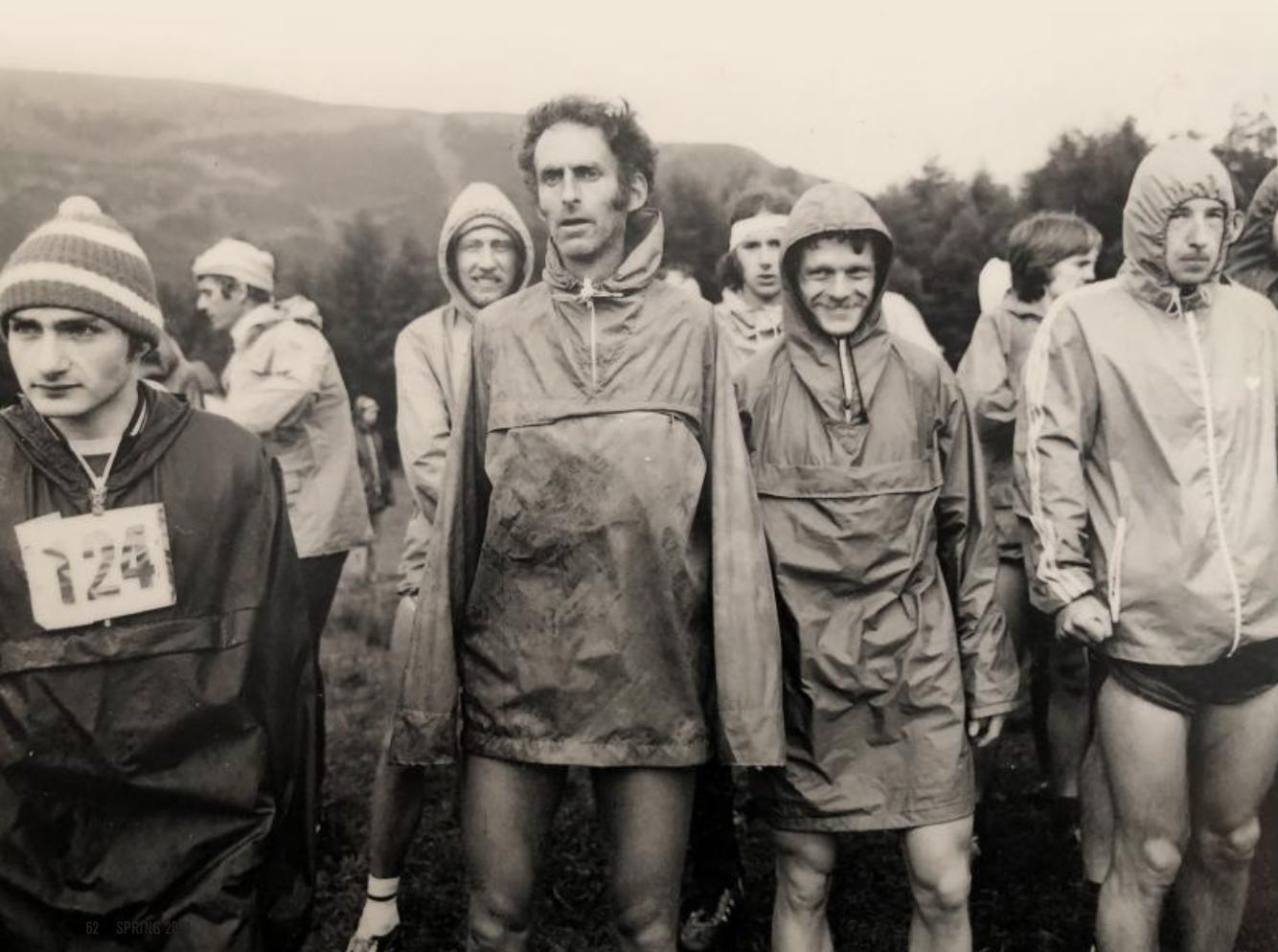
“And we had our own races, and they could be really cutthroat – they were fierce. Fast as any championship race!” he laughs.
I ask, as his running and racing developed in the mid-70s, what his ambition was: was he there to win, or just to enjoy it? He tends towards the latter.
“I don’t remember it being a real problem. It was fun with some serious intent because the amount of time I used to put in running – around 70 to 100 miles a week – or skiing about 2000km at the start of the year, there’s some seriousness there, isn’t there?
“Sure, I have done well; won cameras, percolators, sleeping bags – but that’s not why you do it. It’s for the buzz and the,” he searches for the word: “Endomorphins, or whatever they are!”
We chat for a while about this, reflecting on my own racing and challenges when the clock becomes everything, but it’s refreshing to be reminded to check-in with the real reason you love the sport.
A slice of history
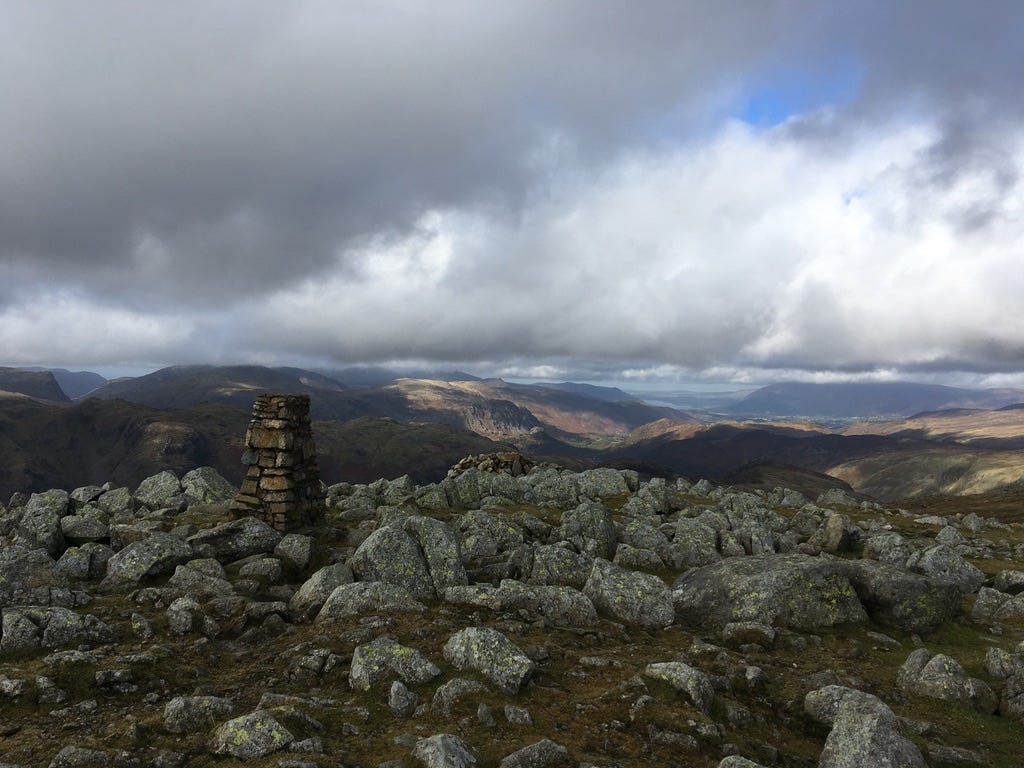
While we’ve been chatting, we’ve been walking up through a woodland behind his house, eventually emerging on the slopes of High Doat. There’s a great view up the Borrowdale Valley, where the sun appears to set about two hours early.
Ash, his collie, drops a crab apple at his feet. “She’s obsessed with these things”, he says, and turns to look down the valley.
“I’m growing apple trees at the minute. There are a few in Borrowdale, but they’re all old, and I’ve got this idea of getting crab apples back in the valley – this is PB’s legacy, so to speak!” he chuckles.
“But Ash finds them. I’ll throw them away, but she keeps picking them up!”
Something else growing in the valley back in the late-70s, though, was a friendship with Billy Bland. Both living in Borrowdale, Pete and Billy – occasionally accompanied by other Blands and Broxap (Broxy, as Pete calls him) – often travelled to races together, such as Ben Nevis.
Pete laughs at a memory he has of when he and Billy used to run together. “I remember a run from Honister to Keswick and back: we were running up a bridleway at the finish. He was ahead of me and he just turns around and says, ‘What you doing? Saving yourself for a sprint finish?’
“There’s just no mercy, is there? I could’ve killed him, but I couldn’t catch him!”
Before helping on Billy’s record-breaking round in ’82, Pete completed his own Bob Graham Round in 1978, alongside Jon Broxap, who went on to run 20 hours 16 minutes. Pete, on the other hand, was suffering, his feet knackered after a hot Duddon Fell Race the week before.
They split up at Dunmail Raise (going anti-clockwise), Pete hobbling back in around 22 hours to become member number 90 of the Club.
Eventually, we come to Billy’s 1982 round, when he set a record which stood until 2018. The timing of this in our walk could not be better: Pete supported on leg two over the Dodds and Helvellyn, the top of which now appears around Grange Fell on our right.
Steve Chilton’s All or Nothing at All captures some of the events of that day. In Pete’s words: “‘I was under a fair bit of pressure that day as I was navigating along the Helvellyn range in really bad weather… It was thick mist and for me to have got that wrong would have been a terrible thing. Billy might have been a bit upset!’”
Pete tells me: “I’d like to think he only picked people who could keep up!” He pauses, and then says: “I personally think they’ve got a huge advantage now: the atmosphere’s changed; it’s been done; you’ve got a target; you’ve got a schedule.
“[Billy] just set off and ran with a few folk, with no set time or schedule, just by the way he felt. He sat down for 23 minutes, so now people know they’ve got 23 minutes if they don’t stop. He met someone with a bag of sandwiches and stopped to have a crack. All that stuff.”
Pete isn’t ever one to romanticise, though, and makes it clear he’s hugely congratulatory towards Kilian Jornet and the like*. Indeed, in keeping with tradition, Pete’s son Martin supported Kilian on his super-fast round.
“I think Billy’s pleased it’s broken now, too. It’s everyone’s round.”
Adventures in the north
Pete likely drew upon the navigation skills he built up over many mountain marathons over the years to get them across the Dodds in one piece. Beside him on many of those mountain marathons was Jon Broxap.
“I met Jon through YHA; he was at Patterdale Youth Hostel. Jon was a brilliant runner – he was so driven. I remember at Kinniside fell race, you finish in the rugby field, and Jon and I were running neck and neck.”
“And the difference between me and Jon was he would turn himself inside-out to win, he would throw up on the line. I just couldn’t do that.”
Pete chuckles: “I remember we got stuck behind some sheep on our Bob Graham, and Jon was so angry because we lost about 30-seconds!”
It’s that kind of drive, though – sheep or no sheep – that helped Jon set the Munro record, climbing 28 (now 29 due to revisions) Munros** in 24 hours.
“We dropped off the north ridge and started towards Beinn Fhada, which is about as steep as grass can be, and I just stopped dead”. And he does, mimicking his dumbstruck face on that day. “And he ran it, he ran the whole thing. It was phenomenal to see.”
It isn’t all about the big challenges and the racing, sometimes nature can be just as awe-inspiring.
“I helped on the last leg, too, onto Mullach Fraoch-choire, and we had Scotland at our feet. We were on the top, with an inversion. And I tell you, that is what this business is all about.
“It’s the experience of what you accumulate over time, memories – and I can go on all day – but also to be with someone who just put themselves through a ringer and done something that’s never been done before.”
What I notice as we talk is Pete speaks very little about himself and his work in these stories. Despite being an integral part of Bland and Broxap’s support, he talks much more about their achievements.
His humility is admirable, and he represents much of what people love about the sport of fell running.
Man of the fells
Nowadays, Pete, who has reached bus pass age. He isn’t running, but that deep passion for nature discovered as a young boy persists. The pull that took him from his first job at a desk drawing maps to working in youth hostels continues to pull him to the outdoors, and not a day goes by he isn’t power-hiking up High Doat or working on the slopes of Helvellyn.
He speaks with pride about his work at Bassenthwaite Lake, working to reintroduce Ospreys to the Lake District, and having been out planting alpine plants in secluded corners of Helvellyn, I can see the buzz it gives him. A fresh kick of “endomorphins”.
But there’s a despondency lurking within him. “I’ve done duck counts on Bassenthwaite for 20-odd years, and when I first started, we had around 600 coots on the lake. Couple of weeks back, I went to do my survey – not one.
“We have to remember the dangers of shifting baseline syndrome,” he says. This is the idea people believe what is ‘normal’ to be what they have grown up with.
He uses me, 40 years his junior, as an example: “What you, as a younger person see as normal, I don’t see as normal.” He indicates the woodland around us. “It’s a wonderful environment, but it’s degraded, and it’ll be a massive challenge to turn it around.”
Pete concedes he has been part of that, though, admitting his tendency to run the shortcuts over the fells, or to take the racing lines over the BGR.
“I’ve played in the Lake District as much as anybody, and I still do. We do need to recognise fell running has an impact, and there are things we can do to minimise it by not cutting corners or doing lots of recces on trods.
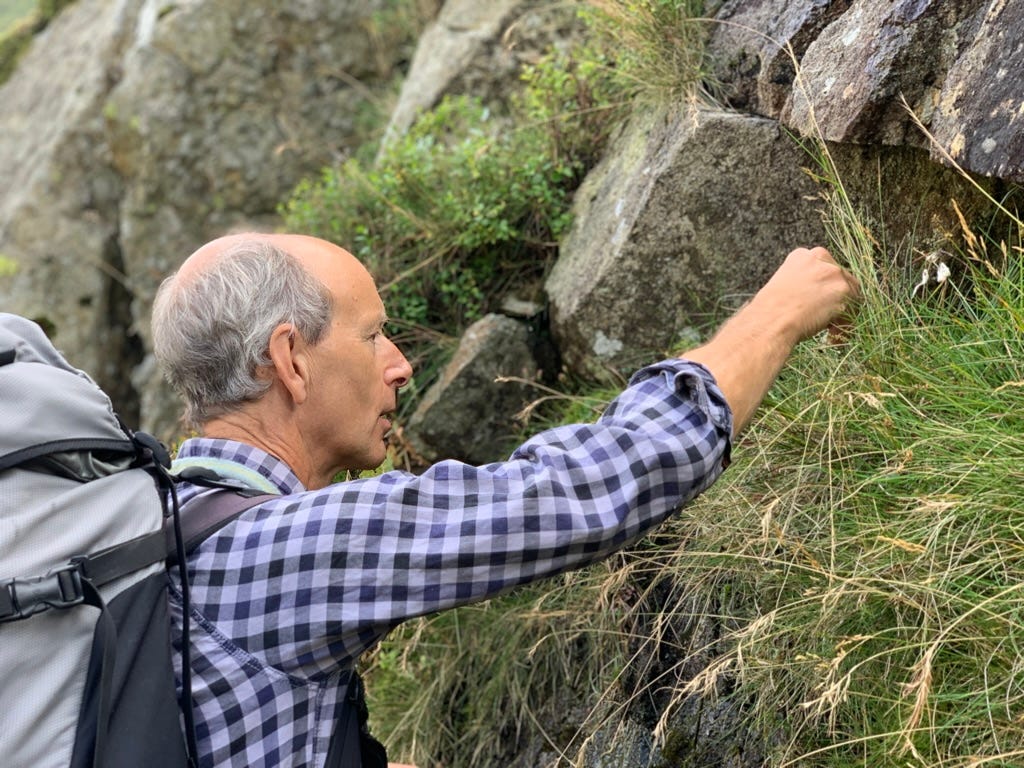
“It’s kind of ironic,” he muses. “One of the people who’s damaged these hills is also one of the ones trying to fix them all the years. So, I have got a bit of a conscience, I suppose!”
In a way, that’s why I wanted to speak to Pete and learn more about him. He stands in the background of photos with Bland, Broxap and others, and even now works in the background to repair and care for the natural environment he loves, and we all enjoy.
We near the end of our walk, coming down the grassy slopes of Castle Crag, and I ask him what he makes of the name ‘The Guy in the Background’.
“It’s about right, really. I’m not a foreground kind of person; if I do something, I do it, know I’ve done it and go away.
“It was amazing to run with these people and run to a standard that stands up to today’s times. In those days though, I was nowhere – I was the man in the shadows, but I think I liked that.”
Just as the sun sets behind us, he reflects on his previous memory on Muallach Fraoch-choire, on that fateful day in 1988: “You don’t remember the hurt, you just remember the sunshine, and that’s what it’s all about, isn’t it?”
So, next time you run across Helvellyn, take a moment to appreciate a man of the fells, whose unwavering commitment to his friends and this landscape epitomises much of the good in our sport.
*Since publication, Kilian’s time has been beaten by Jack Kuenzle in 12:23.48.
**Munros are peaks in Scotland over 3,000ft.There are other criteria that must be met and, due to re-measuring, some peaks are upgraded or downgraded. At present, there are 282 Munros in Scotland.